Pushpak Viman
Finding people under debris, from a transforming drone
A rescue vehicle that drives where it cannot fly, and a detection pipeline trained to find a person in rubble rather than a person in a photograph.
Problem
A person trapped under debris does not look like a person. They look like an arm, or a patch of fabric, in an image mostly made of broken concrete, which is a different detection problem from the one most models are trained on.
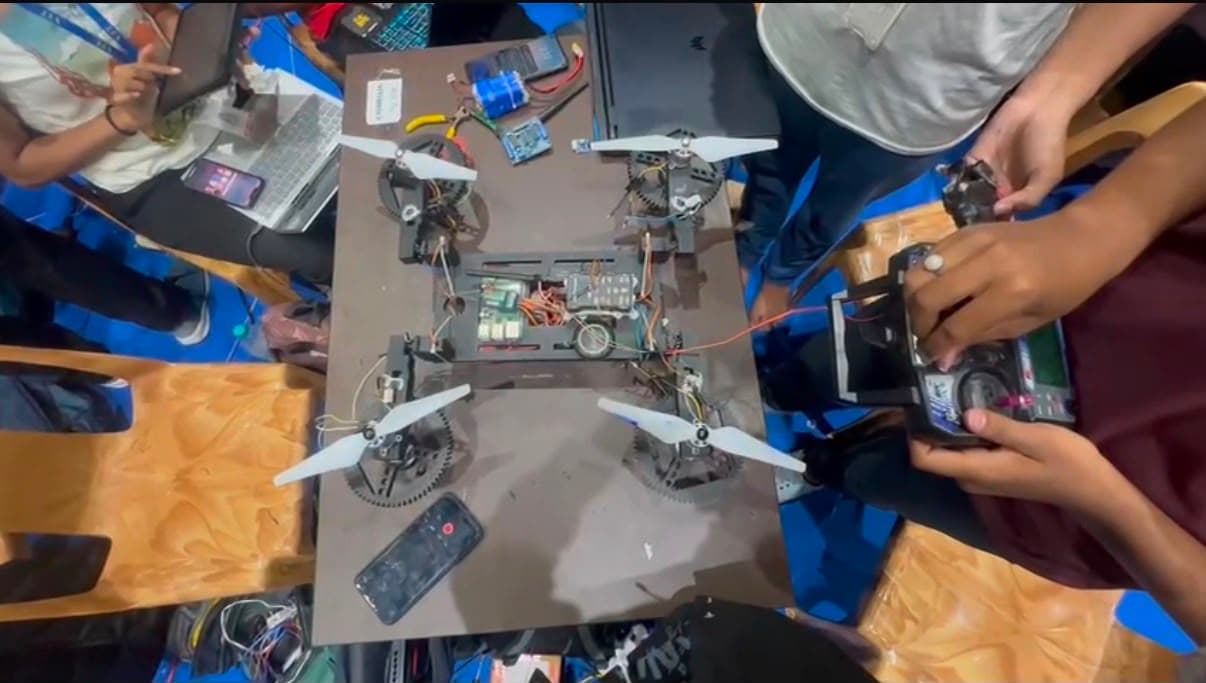
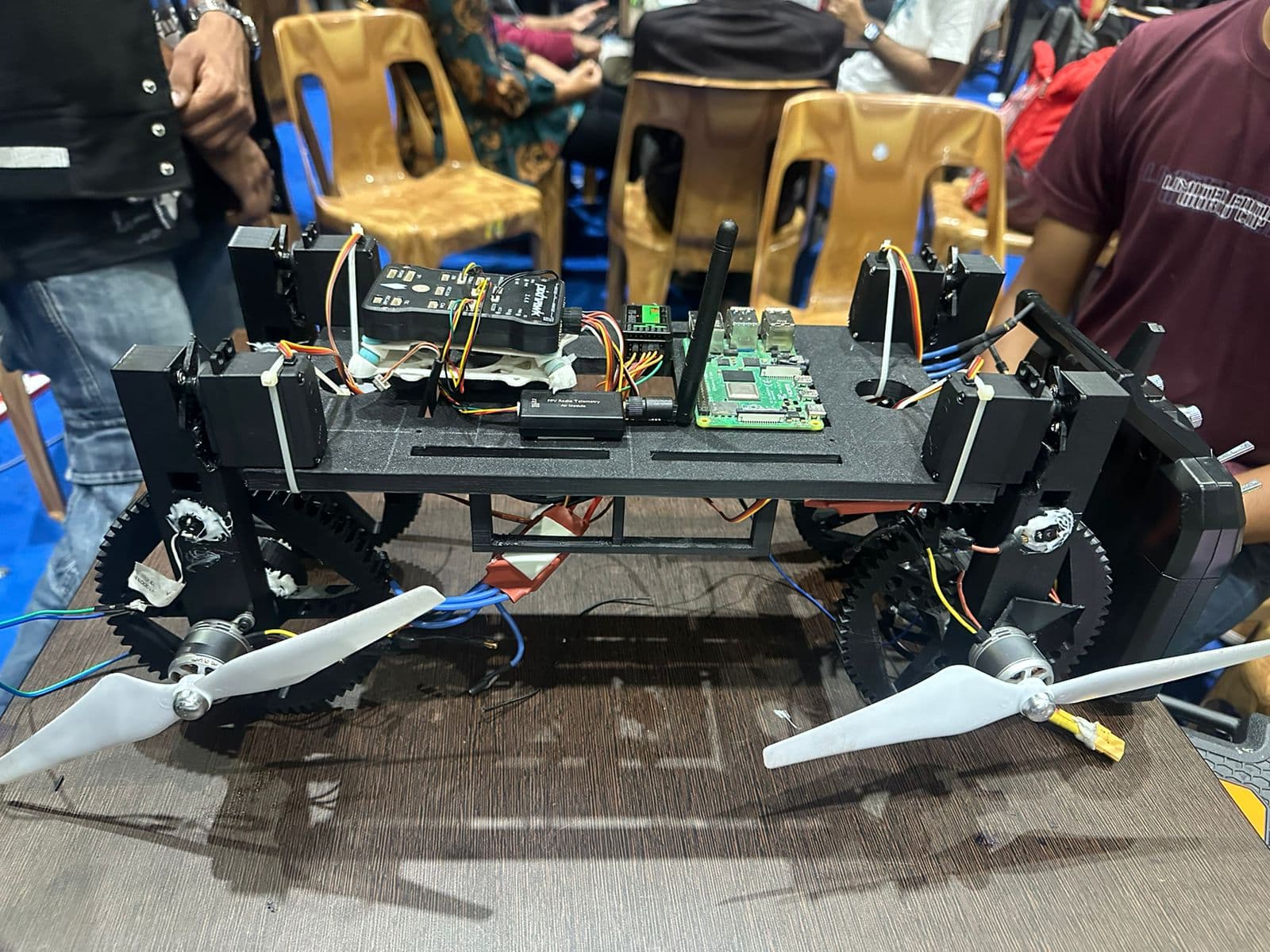
Reaching them is a second problem. A ground vehicle gets blocked; an aircraft cannot enter a confined space or linger. The platform carries propellers and geared drive wheels on the same four arms so it does not have to choose.
What we built
A complete pipeline from raw dataset to real-time inference, and the vehicle it runs on.
- Automated splitting of a victim-under-debris dataset
- Annotation conversion from Pascal VOC XML through CSV to TFRecord
- Detection model training and inference with TensorFlow Lite and YOLOv5
- Real-time video and image inference with bounding-box visualisation
- Hand-landmark tracking via MediaPipe for gesture-based control
- Satellite land-cover classification for navigation context
- A drone-rover platform whose arms carry both propellers and drive wheels
From a dataset to a vehicle that can act on it
Most of the work is before the model, a detection pipeline is only as good as the annotations feeding it, and converting them correctly is where the time goes.
Collect victim-under-debris imagery
Split the dataset
Automated, so the train/test boundary is reproducible rather than ad hoc.
Convert annotations
Pascal VOC XML → CSV → TFRecord.
Train detection models
TensorFlow Lite and YOLOv5.
Real-time inference with visualisation
Detection, flag the position for the rescue teamNothing, keep searchingReach the location
Drive on the geared wheels, or fly when the ground runs out.
One vehicle, two modes
The arrangement is the subject of a patent filing: four arms carrying both the propellers and the geared drive wheels, so neither mode needs separate hardware.
| Mode | Uses | For |
|---|---|---|
| Rover | Geared drive wheels on the four arms | Rubble, confined spaces, long dwell time |
| Drone | Propellers on those same arms | Ground the vehicle cannot cross, overhead search |
| Both | Visual detection and GPS-denied operation | Finding a person who cannot be seen |
Limitations and failure modes
- Detection was trained and evaluated on a collected dataset, not validated in a real rescue.
- The satellite land-cover work supports navigation context; it is not a victim-detection result.
- A prototype and a competition entry, not a deployed system.
Gallery
Attribution
- My contribution within a team
- Pushpak Viman is my project and I led the team. The detection pipeline in the repository was implemented with teammates rather than by me alone.
- Built by me
- The transforming drone-rover arrangement, which is the subject of a patent filing.
- Based on external research
- YOLOv5, TensorFlow Lite and MediaPipe are upstream. The satellite land-cover dataset is from the MDPI Remote Sensing journal.
Related
- Autonomous VTOL UAV
A search-and-rescue airframe with thermal victim detection
- OpenDroneKit
Offline drone inspection, mission planning, flight, geospatial reconstruction and defect intelligence